Introducing Dual Governance: A New Era of Ecosystem Participation
Today we are launching Dual Governance. To mark the occasion, we want to explain how the governance system behind Dual is designed, how a proposal travels from an initial idea to an executed on-chain decision, and what it means for the long-term direction of the network.
The launch of the Dual Mainnet moved Dual from enterprise-proven infrastructure toward a more open, decentralized protocol. Staking was the first step in that direction, connecting the wider ecosystem to the value the network generates in real time. Governance is the natural continuation, connecting that same ecosystem to the decisions that determine where the protocol goes next.
For most of Dual's history, the direction of the protocol was set through client projects, enterprise integrations and core development. With the Dual DAO, that responsibility becomes shared. Every xDUAL holder now has a direct say in which improvements are proposed, how they are refined, and whether they are adopted.
The sections below cover how the governance layer is structured, how a proposal moves through it step by step, and how the system is built to keep the protocol open, deliberate, and aligned as it grows.
How the Process Works, Step by Step
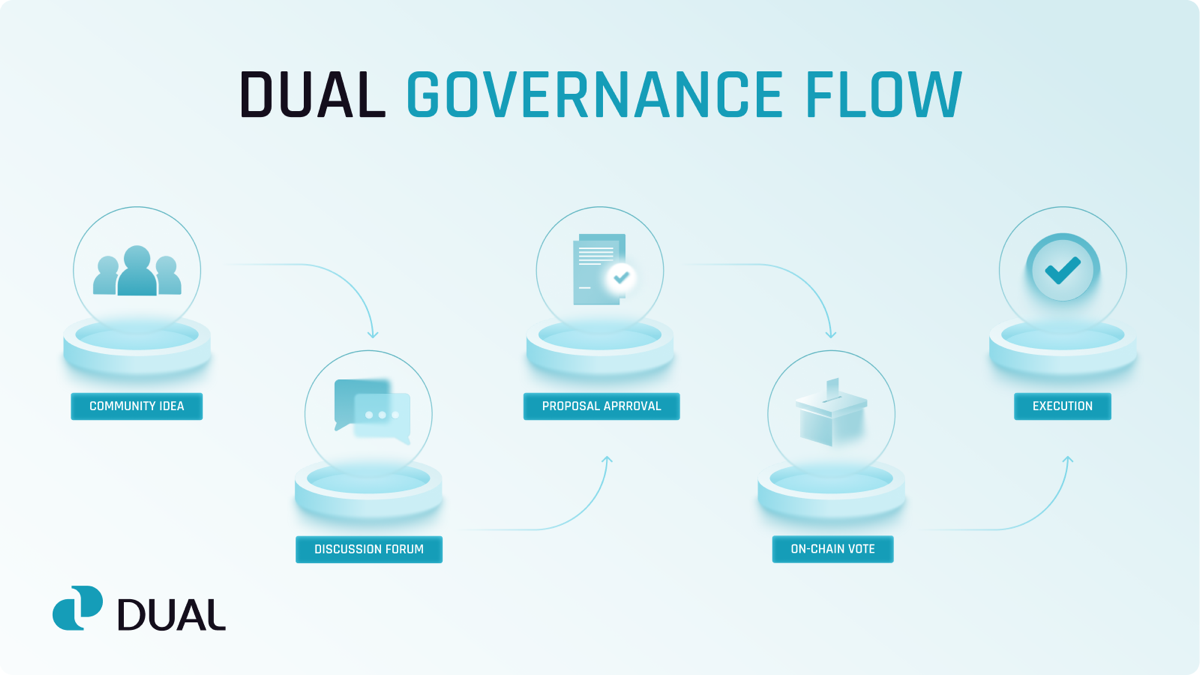
Governance is about more than the final vote. It is about ensuring that by the time a binding vote takes place, an idea has already been discussed, refined, and validated in the open by the people closest to the ecosystem. That principle shapes the entire process, which follows five clear stages from an initial idea to an executed decision.
Step 1: Community Idea
Every proposal starts as an idea raised by a member of the community. Any holder can put one forward and set out the reasoning behind it. This is the starting point of governance, where anyone with a view on how the protocol should develop can bring it to the table.
Step 2: Discussion Forum
The idea is then opened for discussion on the Dual Forum, where the community can question, challenge, and improve it. This is the stage where an early idea becomes a considered proposal, shaped by the people who will ultimately be affected by it.
The forum runs on Dual, using the same infrastructure as the rest of the ecosystem. Authentication is handled on Dual, so signing up creates a Dual Wallet automatically as part of joining the forum.
What matters most about this stage is that it is open to everyone on equal terms. Anyone can raise an idea, and anyone can take part in discussing and validating it. Participation here is not tied to how much DUAL a member holds or how much voting power they carry. Every voice counts the same, so the strength of an idea is measured by the merit of the argument and the breadth of community support behind it, not by the size of anyone's holdings.
That support is captured through a forum sentiment poll. Each proposal has its own poll, which can open automatically or be started by an administrator, and its final result is recorded on-chain on Dual. The community sentiment behind a proposal is therefore not a figure stored in a database that could later be altered. It is a verifiable, on-chain record of where the community stands. This stage runs for a minimum of 14 days, giving every proposal enough time to be examined properly and to demonstrate genuine support.
Step 3: Proposal Approval
With a positive forum poll behind it, the proposer submits the proposal at the Voting Portal, which requires holding at least 1,000 xDUAL. The Governance Council then conducts a short review against a published checklist. It confirms that the process was followed, that the discussion took place over the required period, that the sentiment poll demonstrates genuine backing, and that the proposal was submitted under the correct category. This is a check on process, never on merit.
Where a proposal does not meet the procedural requirements, the Council provides written reasons, and the proposer can correct and resubmit it or ask the Council to reconsider. Proposals that meet the criteria are then formally advanced to an on-chain vote through a multi-sig action, ensuring that the step from approval to vote is itself transparent and requires coordinated sign-off rather than a single unilateral decision. The Council completes this review within 48 hours.
Step 4: On-Chain Vote
The approved proposal then moves fully on-chain, where xDUAL holders cast the binding vote through the Voting Portal over a 14-day voting period.
The Voting Portal is powered by Aragon, one of the most established governance frameworks in the industry and the same infrastructure used by leading protocols such as Lido, Curve, and Decentraland. Building on Aragon means Dual's on-chain governance rests on audited, widely used contracts.
Alain Kunz, an Advisor to the Dual Foundation's Ecosystem and Partnerships Council, is also a board member of the Aragon Foundation. We want to be transparent about that relationship: the selection of Aragon as the governance infrastructure for Dual was made independently of Alain's role there.
The parameters set for launch follow a single principle: everyday participation should be easy, and consequential change should be deliberate.
Submitting a proposal requires holding 1,000 xDUAL, a deliberately low and symbolic figure chosen to keep governance accessible to the wider community rather than only the largest holders, even if the token appreciates over time. As set out above, a proposal moves through at least 14 days of forum discussion, up to 48 hours of Council review, and a 14-day binding on-chain vote if it advances.
For a binding vote to be valid it must reach quorum, the minimum share of eligible staked voting supply that takes part. Treasury Grants require 10%, while Ecosystem Direction and Protocol Improvements require 20%, reflecting their greater weight. Once quorum is met, a proposal passes on a simple majority of more than 50% of participating voting power. This majority is the same across all three categories; what differs is how much of the community must show up for the vote to count. Setting the bar through participation rather than an ever-higher majority means the most consequential decisions require broad engagement before they can pass, while everyday decisions remain straightforward to move forward.
Step 5: Execution
When a vote passes, the decision proceeds to execution, carried out by the Dual Foundation. Where executing an approved proposal would be unlawful, technically impossible, or an immediate threat to network security, the Foundation must publish its reasons and refer the matter back to the governance process as soon as reasonably practicable.
The full timeline at a glance
Taken together, a proposal moves through at least 14 days of forum discussion, up to 48 hours of Council review, and a 14-day binding on-chain vote if it advances. In practice that means a considered process of roughly a month from idea to executed decision, with each stage clearly bounded so that nothing is rushed through.
The forum keeps the community close to active decisions throughout. Its homepage surfaces the on-chain votes currently live on the Voting Portal, so members can move from reading a discussion to casting a vote without leaving the platform. It also issues on-chain achievements directly into members' wallets as they reach milestones, providing a native way to recognize participation and a practical example of the programmable assets Dual was built to support.
Throughout, governance on Dual runs on the same infrastructure it governs. The forum sentiment poll, the on-chain voting, and the recognition of participation are all recorded on-chain and independently verifiable.
Who Runs the Process
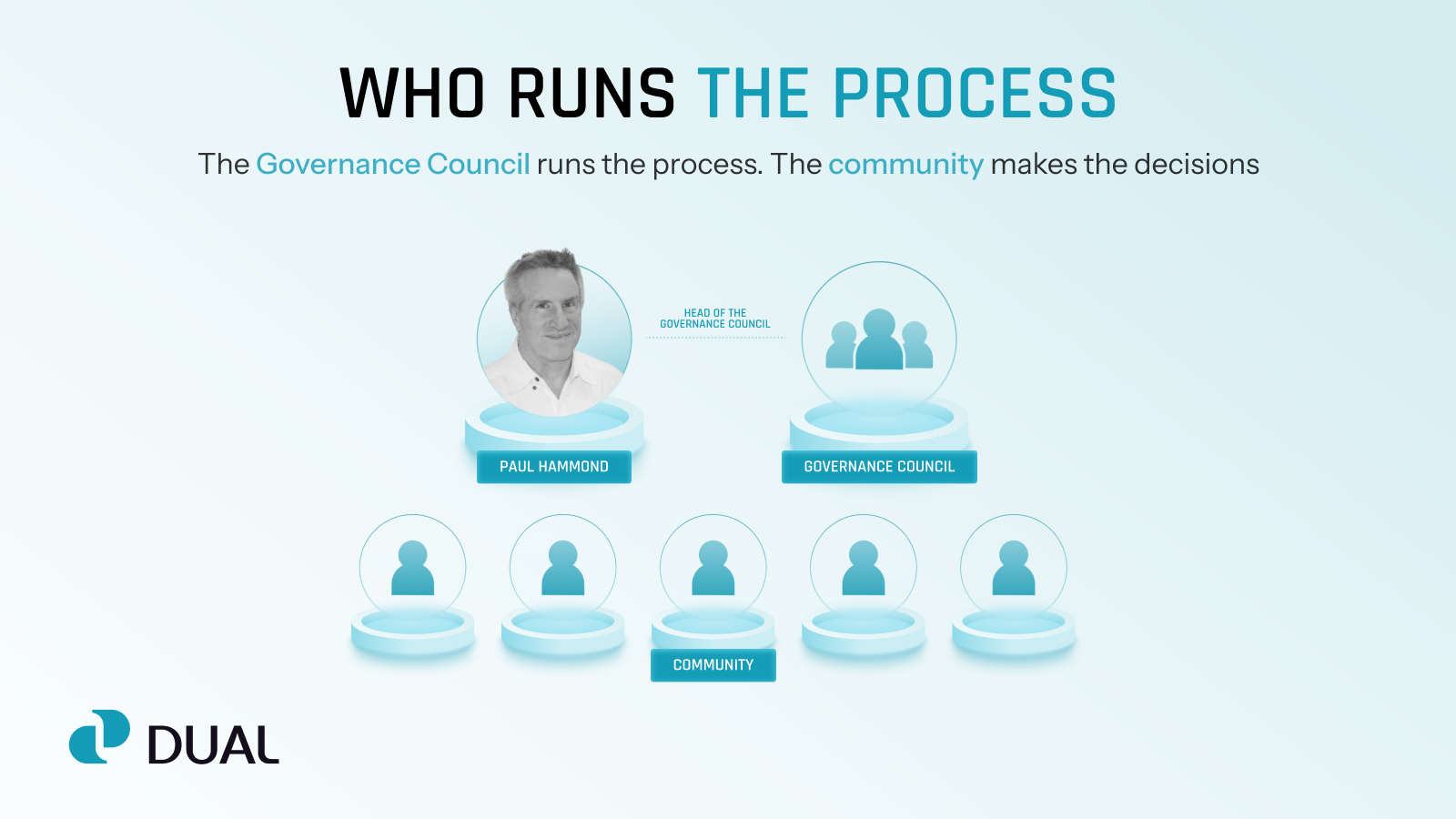
A fair process needs someone accountable for running it. The Dual DAO is administered by a Governance Council, chaired by Paul Hammond, a long-standing DUAL holder with decades of experience across technology and crypto as both an investor and an operator. The role is intentionally narrow. The Council runs the process; the community makes the decisions.
That separation is what keeps the process trustworthy. The approval a proposal passes through is not an opportunity for the Council to favour ideas it prefers. It is a check that the process was followed and that the community's on-chain support was genuine. Proposals that meet the criteria advance to a vote, and the outcome rests entirely with the community.
At launch, the Council comprises the Chair together with a representative of the Dual Foundation, and it will be expanded over the coming months to include members independent of the Foundation. The governance multi-signature evolves in step: as independent members join, the signer set widens and the Foundation's share of signers reduces. Members who want to help shape how the process is run are encouraged to get involved.
How to Vote on Governance Proposals
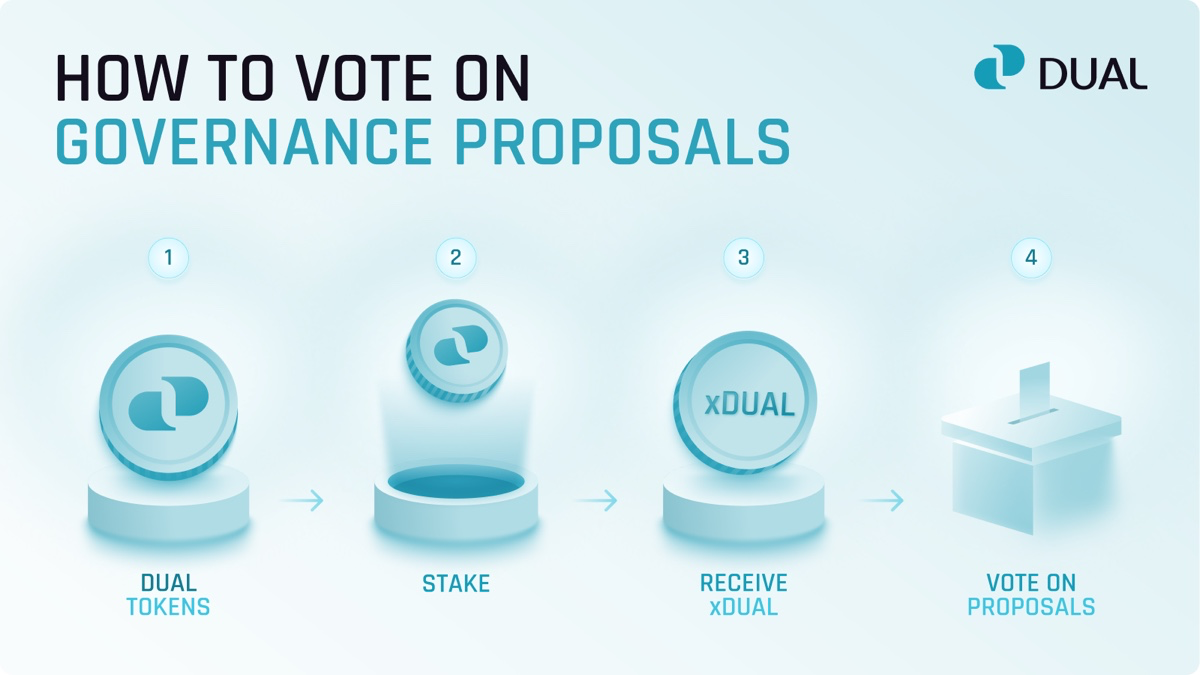
Governance participation follows directly from the staking system that holders already use, and the path is intentionally straightforward.
It begins with DUAL. When holders stake their DUAL, they receive xDUAL in return, and xDUAL carries governance rights. Holding xDUAL assigns voting membership automatically, with no separate registration, and no additional requirements to take part.
Your eligibility to vote on a given proposal, and the voting power you carry, is fixed by the xDUAL you hold at the moment the proposal is submitted for its on-chain vote. Acquiring or staking more xDUAL after that point does not increase your voting power on that particular proposal, so holders who want a say should be staked and holding xDUAL ahead of the vote being submitted.
Tying governance to staking is deliberate. The holders who help secure and support the network economically are the same holders who guide its direction, which keeps incentives and decision-making aligned around the long-term health of the ecosystem
The Types of Proposals
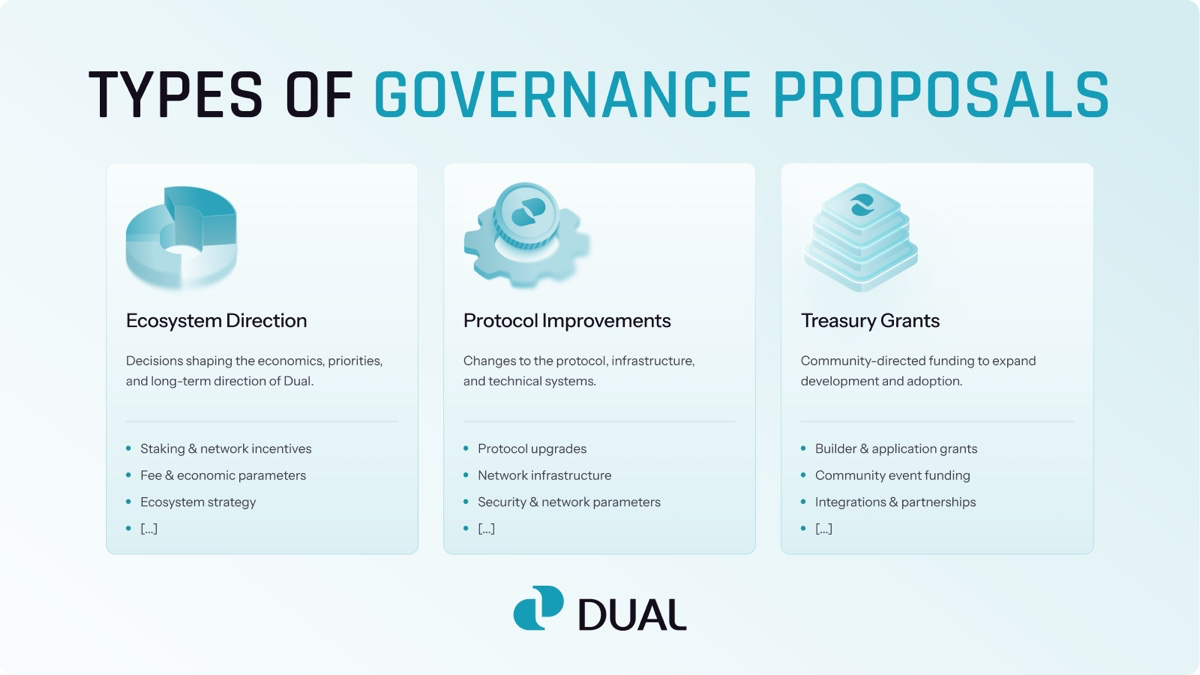
Governance at Dual spans the strategic, technical, and economic direction of the protocol. To keep those distinct decisions clear, proposals are organized into three categories, each operating as a separate stream with its own quorum requirements.
- Ecosystem Direction covers decisions that shape the economic priorities and long-term direction of Dual, including staking and network incentives, fee and economic parameters, and broader ecosystem strategy.
- Protocol Improvements covers changes to the protocol, infrastructure, and technical systems, including protocol upgrades, network infrastructure, and security and network parameters.
- Treasury Grants covers community-directed funding to expand development and adoption, including builder and application grants, community initiatives, integrations, and partnerships.
The categories exist for a practical reason. A treasury grant and a change to the network's economics are very different decisions, and each warrants a quorum that reflects what is genuinely at stake.
First Proposal
A governance system is only as good as the participation behind it, and the clearest way to show how it works is to put a real proposal in front of the community from day one. Rather than open the forum as an empty page, we are launching it with a live first proposal that also marks the first use of the treasury: a developer grant programme.
The proposal, submitted under Treasury Grants, is straightforward. It proposes a developer account balance of 10,000 DUAL to each of the first 100 qualified developers who register through the developer portal, a total of 1,000,000 DUAL. When 100 grants have been issued the programme stops, and extending it would require a new proposal and a new vote.
The reasoning is to pay for the scarcest input the network has right now, which is a developer's attention. The grant is designed to get a builder spending a week building on Dual, starting the moment the portal opens, with no gates and no waiting. Paying up front is the fastest, cleanest way to earn that attention, and the proposal makes the case that it is better to back builders directly than to put process between a developer and their first line of code on Dual.
It is also deliberately bounded. Qualification is tied to a verified work email domain, with one grant per domain and per team, wallet deduplication to prevent double claims, and standard sanctions and jurisdictional screening before any payout. The 1,000,000 DUAL cap is roughly 0.01% of total supply, a small and legible cost, and the grant authority expires two years after execution, with any undistributed portion returning to the treasury automatically.
The proposal is honest about its trade-offs. Domain verification is not perfect, and the proposal invites the community to suggest a better filter or a different pilot size if 100 developers is not the right number. That is exactly the point of putting it to the forum first.
This is what makes it an ideal opening proposal. It is a real decision with real trade-offs, it commits real funds from the treasury, and it sits squarely within the DAO's remit. Over the coming days it will move through each stage of the process in the open. The community can discuss it on the forum, weigh in through the sentiment poll, and, once it passes review, cast the binding vote on-chain. We would encourage every holder to follow it through, not only to help shape the outcome, but to see for themselves exactly how an idea becomes a decision on Dual.
The Next Layer of the Programmable Economy
Staking gave holders a role in the network's economic layer. Governance extends that participation to how the protocol itself evolves. Together they complete Dual's transition from infrastructure operated internally into a network that is genuinely shared.
The technology behind Dual has already been proven at scale through years of enterprise deployment. What governance changes is who directs it. The protocol no longer advances solely through decisions made internally; it advances through a broad community of participants aligned around the same infrastructure, the same economics, and now the same decisions.
The infrastructure is live and the staking is active. As of today, the community sets the direction across staking and network incentives, protocol improvements, and treasury grants.
Dual Governance is live. Stake DUAL, join the forum, and help decide what comes next.