Introducing Dual Developer Console: The Builder Interface for the Programmable Economy
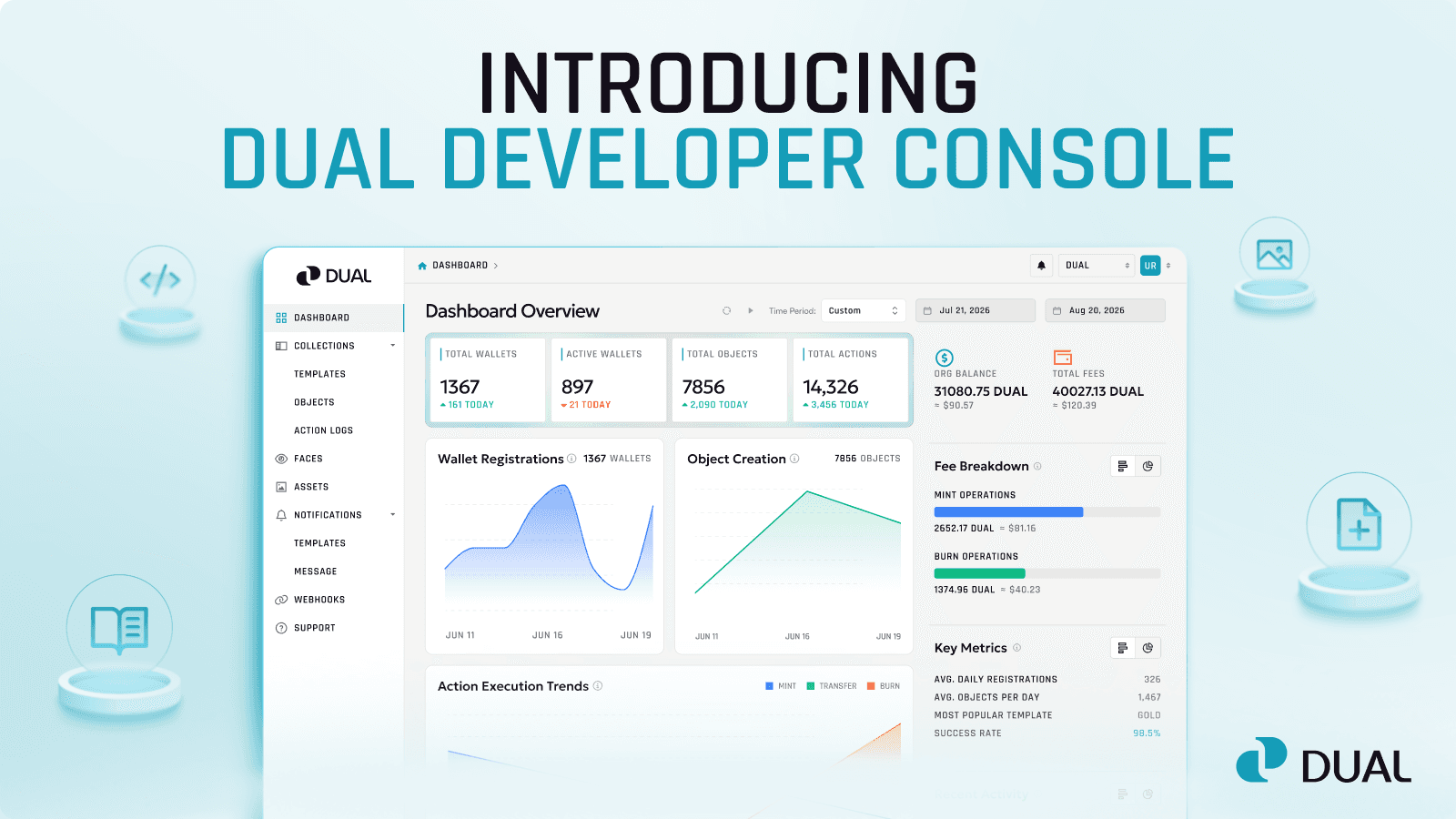
Today we are launching the Dual Developer Console, a new developer-facing interface for building, managing, and monitoring applications on Dual’s L3 architecture: the Dual Network & Protocol.
Dual has always been designed around programmable infrastructure that developers can integrate directly into applications through APIs. The Developer Console adds a visual interface to that infrastructure, bringing the core tools and information developers need into one place.
Developers can create templates and programmable objects, manage organizations and API access, fund their applications with DUAL, and monitor activity across their deployments without having to manage every interaction directly through an API.
It is another step toward making the infrastructure behind the programmable economy easier to access, understand, and build with.
One Place to Build on Dual
Building an application involves much more than making the first API call.
Developers need to define the structure of their programmable objects, create and manage them, organize assets, control access, fund protocol activity, understand what users are doing, and monitor how an application behaves once it is live.
The Dual Developer Console brings those workflows together.
From a single interface, developers can work across the lifecycle of an application, from initial configuration and creation through to ongoing activity and management.
The Console provides access to areas including:
- Templates, where developers can define the structure and behavior of the programmable objects used by their applications.
- Objects, where those templates can be used to create and manage individual programmable objects.
- Assets and Faces, providing components that shape how objects are represented and experienced.
- DUAL Balance, where developers can monitor and top up the DUAL available to their organization for protocol activity.
- API Access, giving developers the credentials required to connect their own applications and services to Dual.
- Organizations and Permissions, allowing teams to manage members, roles, and access across a project.
- Notifications and Webhooks, connecting activity on Dual with external applications and workflows.
- Analytics and Activity, giving developers visibility into wallets, objects, actions, fees, and application usage from one place.
At the center of this are programmable objects.
Rather than treating digital assets as static records, Dual allows developers to create objects with their own properties, permissions, behaviors, and interactions. These objects can represent loyalty and rewards, credentials, digital products, ownership, access, and other forms of programmable value.
The Console makes that model directly accessible through an interface. Developers can create templates that define how a particular type of object should behave, create individual objects based on those templates, and manage them directly from the same environment.
The same applies as applications move beyond experimentation.
A prototype may involve only a handful of objects and interactions. A production application can involve large numbers of wallets, programmable objects, actions, integrations, and users operating simultaneously. The underlying infrastructure is the same in both cases.
Through the Console, developers can monitor wallet registrations, follow object creation, understand which actions are being executed, track fees and balances, and see the activity generated by their applications.
Everything is organized around the developer's organization. Teams can manage members, roles, permissions, API access, objects, and activity within the same environment, providing a structured path from individual experimentation to collaborative and production development.
More Than One Way to Build
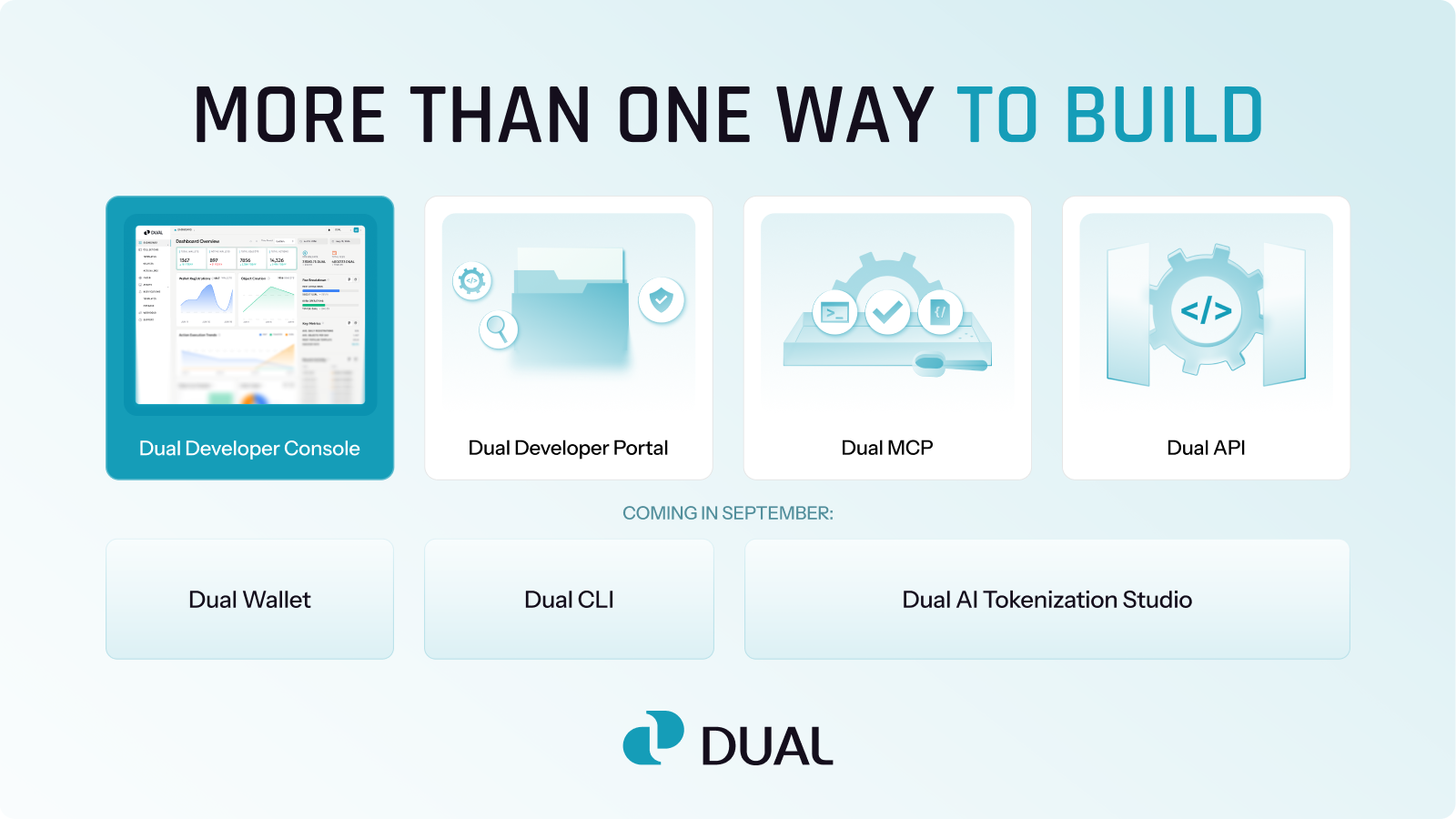
The Developer Console launches as part of a broader Dual developer stack.
Each component provides a different way to work with the same underlying infrastructure:
- Dual Developer Console provides the visual interface for creating, configuring, funding, managing, and monitoring applications.
- Dual Developer Portal is the starting point for understanding Dual, exploring documentation, tutorials, architecture, and API references.
- Dual MCP brings Dual into AI-native development workflows, providing a standardized interface through which compatible AI development environments and agents can interact with Dual infrastructure.
- Dual APIs provide direct programmatic access for custom applications, integrations, and automation.
Coming in September
- Dual Wallet will provide a reference application and wallet framework built on the Dual API, with a hosted environment for testing programmable objects and a foundation teams can fork and customize.
- Dual CLI will provide open-source command-line tooling for developers working from their development environment or performing operations at scale.
- Dual AI Tokenization Studio will add another AI-native way to work with Dual infrastructure.
These are not separate systems. They are different interfaces into the same Dual infrastructure.
A developer might use the Console to configure an organization, fund it with DUAL, and create a template, then use the APIs to connect that template to an application. Larger batch operations can move to the CLI, while MCP creates another path for working with Dual through AI-powered development environments.
The Console does not replace the Dual APIs. It provides another interface to the same underlying infrastructure.
Some operations can be performed visually. Others can be automated or integrated programmatically. The same application can use both.
With Dual Wallet, developers will be able to launch a basic wallet connected to their organization. This will provide a way to experience programmable objects from an end-user perspective without first building a dedicated wallet application. For teams developing their own consumer experience, the wallet will provide a practical environment for testing what they build.
For teams developing their own consumer experience, the wallet provides a practical environment for testing what they build. Developers remain free to create their own wallets and interfaces through the APIs as their applications evolve.
The objective is not to prescribe a single way of building.
It is to give developers the ability to move between visual, programmatic, command-line, and AI-native interfaces depending on the application and workflow in front of them.
A Developer Grant Proposal
Alongside the Developer Console launch, the first proposal under Dual Governance is now live on the Dual Forum.
Submitted under the Treasury Grants category, the proposal would provide a 10,000 DUAL developer account balance to each of the first 100 qualified developers or teams building on Dual.
The developer balance is intended for development activity within the Dual ecosystem. It is not proposed as a direct cash payment or unrestricted token grant.
It is currently open for community discussion and sentiment voting on the Dual Forum. Developers and community members can review the proposal, challenge its assumptions, suggest changes, and signal their support.
If approved, the programme would complement the Developer Console and broader developer stack by giving qualified builders another way to begin working directly with Dual.
Opening Dual to More Builders
The infrastructure behind Dual has already been used across large-scale enterprise deployments.
The next stage is making that same infrastructure increasingly accessible to a broader developer ecosystem.
The Developer Portal opened access to documentation and architecture. Dual Mainnet opened the network. The Developer Console now provides a direct interface for developers to work with the infrastructure itself.
The goal is to reduce the distance between having an idea and building it on Dual.
A developer should be able to understand the infrastructure, create programmable objects, connect them to an application, monitor activity, and move toward production without having to assemble an entire development environment around the protocol first.
Access is initially request-based while onboarding and the platform experience are monitored and refined. The approval process is not intended to be permanent: as the platform matures, the Developer Console will move toward fully open access.
The Builder Interface for the Programmable Economy
The programmable economy will not be built through a single interface.
Some developers will work directly through APIs. Others will use command-line tooling or AI-powered development environments. Teams operating live applications may spend more time in the Console.
The applications they build will ultimately abstract most of this infrastructure away from the people using them. That is already how much of Dual's adoption works today.
Millions of users have interacted with applications built on Dual without needing to understand the blockchain infrastructure underneath them. For the end user, the technology can remain invisible.
For the builder, however, the infrastructure needs to be accessible, observable, and easy to control.
It brings the infrastructure closer to the people building on top of it while preserving the flexibility to move directly into APIs, command-line tooling, and AI-native development workflows whenever more control is required.
Create templates. Build programmable objects. Fund applications. Connect services. Manage teams. Monitor activity. Scale through APIs and developer tooling.
One infrastructure, with more ways to build.
Request access through the Dual Developer Portal and start building on Dual.
→ https://console.dual.network
The Dual Developer Portal is there to support the entire journey, from understanding the architecture and exploring documentation to working with APIs, tools, and resources for building on Dual.
→ https://dual.org/docs
And this is only the beginning of the developer tooling we are opening to the ecosystem. More tools and new ways to build on Dual are already on the way.
Stay tuned for what comes next.