Dual Staking & Tokenomics: The Ecosystem Alignment of the Protocol
With the launch of the Dual Mainnet, alongside staking and governance, we wanted to go deeper into how the staking and tokenomics system behind Dual is designed, how value flows through the ecosystem, and what it means for the long-term growth of the network.
Heads up: Tangem and other wallets not supporting custom EVM networks
We’re currently investigating an issue where Tangem doesn’t support custom EVM networks. That is required because DUAL Staking is only available on the Dual Network, and the staking process guides you through all of the steps of bridging and staking.
Before you bridge: check that your wallet supports custom EVM networks. If it doesn’t, please don’t start the process yet.
If you’ve bridged, your tokens are safe, they haven’t disappeared. They’re on Dual Network, and they stay there until you can access them with your wallet.
If you’ve already bridged and your wallet doesn’t support custom EVM networks.
If you can export your private keys, import them into a wallet that does support custom networks (such as MetaMask) and continue from there.
If you can’t export them (for example, seedless wallets), or you’re unsure, contact us at support@dual.org with the details and we’ll help.
We’ll share an update as soon as we know more.
The launch of Dual marked the transition from enterprise-proven infrastructure into a more open, decentralized protocol. The technology behind Dual has already powered large-scale deployments for years, supporting over 50 million deployed tokens and onboarding millions of users into Web3 through real-world applications.
What changes now is the participation itself. Staking itself is not new; it was available to VEE holders before the transition. What is new is the economics behind it: under the Dual model, staked DUAL earns a direct share of the protocol fees generated by real network activity in real-time, across both public and private deployments.
This article explains how the economic layer behind Dual is structured, how protocol fees flow through the ecosystem, and how staking is designed to reinforce long-term growth across both public and private deployments.
One Network Across Both Public and Private Infrastructure
One of the core ideas behind Dual has always been flexibility.
Not every deployment operates in the same way. Some applications require fully public infrastructure and open participation. Others require dedicated environments tailored for enterprises, institutions, or large-scale commercial deployments.
This is generally not a preference but a requirement. The operators' own clients, often large enterprises, major brands, or regulated institutions, mandate a private setup for reasons including:
- Data residency and privacy: regulatory requirements governing where user data is stored and who can access it.
- Security and compliance: obligations that require a controlled, isolated environment.
- Performance isolation: guaranteed capacity that is not shared with the rest of the network.
- Contractual and brand control: full ownership of the environment the product operates within.
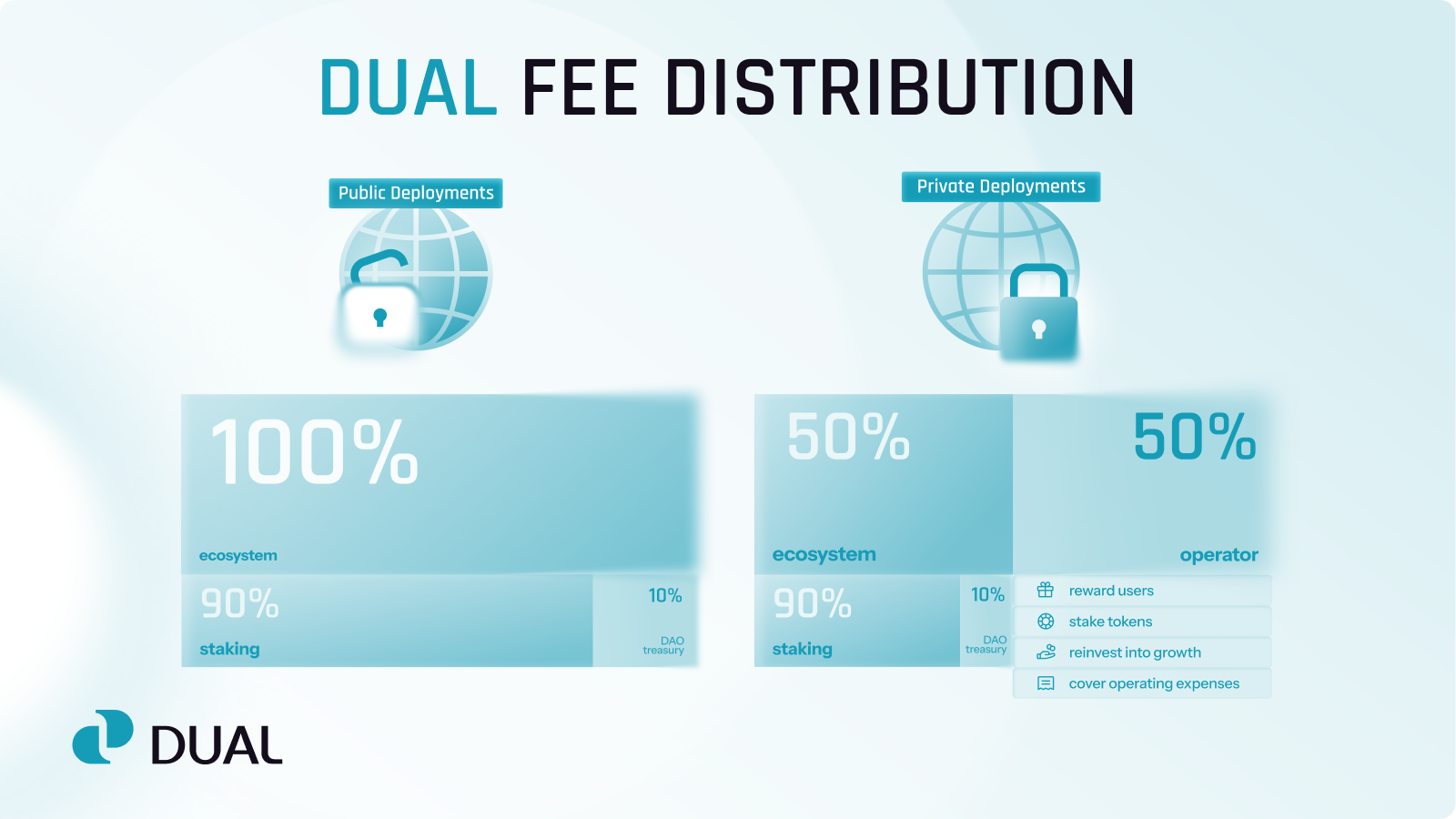
For deployments operating on top of Dual’s maintained public infrastructure, 100% of protocol-generated fees flow back into the Dual ecosystem itself. At the current protocol level, this includes the standard minting fee of $0.02 per object minted paid in DUAL, alongside other protocol fees, which will be introduced in a future article in detail related to the transaction fees, programmable actions, yield, the fee model for Points, and more.
Those ecosystem fees are then distributed with 90% flowing toward staking participation and 10% allocated to the Dual DAO Foundation Treasury. The reasoning behind that structure is straightforward. As more applications, deployments, and users generate activity across the network, the majority of the value created by that usage flows back toward the participants helping secure and support the ecosystem itself.
Private enterprise deployments with partners such as SmartMedia Technologies already operate dedicated private environments connected through the Dual Protocol. In these cases, protocol-generated revenue is split evenly between the Dual ecosystem and the deployment operator itself.
The ecosystem portion continues flowing back into staking and treasury allocations, while the operator allocation gives enterprise partners flexibility in how they grow and manage their own deployments. Depending on the ecosystem itself, those allocations may be used to reward end users directly, stake DUAL through the staking system, reinvest into future campaigns and growth initiatives, or support the infrastructure and operational costs associated with maintaining the deployment.
This structure is important because different ecosystems naturally prioritize different growth strategies. Some may focus heavily on user rewards and participation, while others may prioritize long-term infrastructure expansion or staking participation within the network itself.
At the protocol level, however, the alignment remains consistent. Whether activity happens on public infrastructure or within private enterprise deployments, the Dual ecosystem and DUAL stakers continue benefiting from overall protocol growth across every connected environment using the protocol.
Because the fee is fixed in dollars ($0.02) but settled in DUAL, the quantity of DUAL per mint varies with DUAL's price over time. So a fee total expressed in DUAL won't divide evenly into a single fixed “DUAL per token” figure across different periods, it simply reflects the price at the time of minting.
The goal is to create the infrastructure for the programmable economy where operators, companies, builders, and eventually agent-driven systems remain economically connected through the same protocol layer underneath.
Staking as Reinforcing Ecosystem Growth
The staking layer inside Dual is not designed as a standalone rewards mechanism disconnected from actual protocol activity. It is a reinforcing system where network growth, ecosystem participation, and long-term alignment strengthen one another over time.
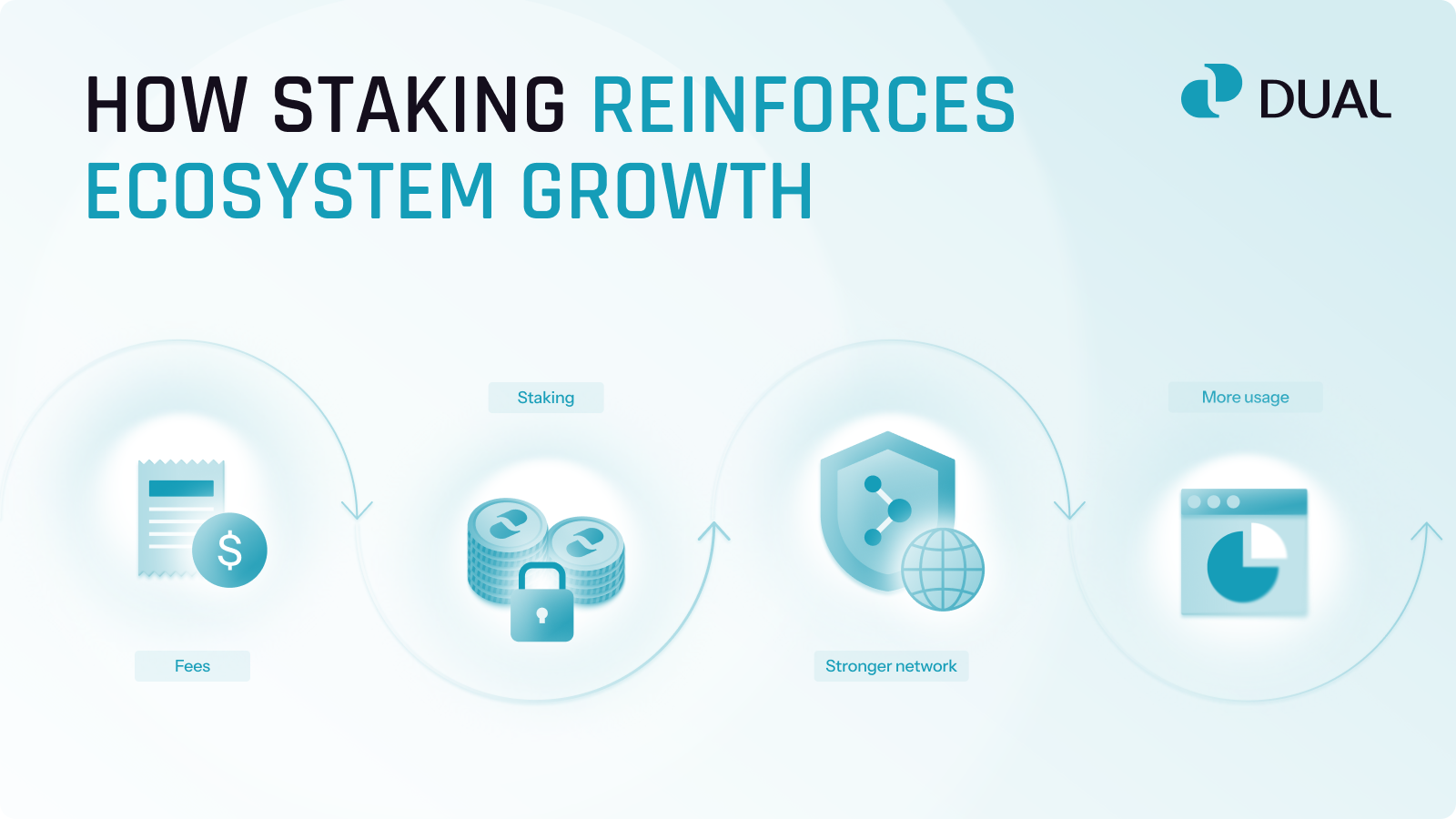
As more applications launch on top of the protocol and more activity flows through the network, protocol fees begin flowing back into the ecosystem itself. Those flows reinforce staking participation, which strengthens coordination across the network and helps support additional adoption, deployments, and integrations.
That stronger ecosystem then attracts more activity, which creates additional protocol usage, which again reinforces staking participation and ecosystem growth. Over time, the relationship becomes increasingly self-reinforcing, creating a compounding effect where network expansion and ecosystem participation continuously strengthen one another.
This becomes especially important as programmable assets move beyond experimentation and into large-scale production environments.
The infrastructure behind Dual was already proven through enterprise deployments for several years. What staking changes is that the broader ecosystem can now participate directly in that growth instead of simply observing enterprise activity from the outside. As more activity flows through the network, the relationship between usage and participation becomes increasingly connected.
The protocol no longer expands only through enterprise integrations. It expands through a broader ecosystem of participants aligned around the same infrastructure layer and economic system supporting the network underneath.
The fee distribution itself is handled by an on-chain fee dispatcher, which continuously routes protocol fees into the staking contract as they are generated.
Rewards are distributed across a 7-day rolling window, meaning fees arriving into the contract are proportionally allocated to stakers over the following seven days. To benefit from the full proportional share of any fee dispatched, stakers need to have their DUAL staked for the full 7-day window.
This design rewards sustained participation over short-term positioning, aligning staker incentives with the long-term health and stability of the network.
Launch Rewards, Staking Allocation, and Long-Term Security
Since May 8th, when staking on BLOCKv was paused ahead of the launch of the Dual Mainnet and Staking, approximately 36M DUAL in protocol fees have accumulated and will now be distributed to the community. Half will be released immediately at launch as an early arrival bonus, participants who stake at launch benefit directly from the activity the network has already generated. The remaining half will be distributed over five weeks starting July 1, allowing the rewards to flow further steadily into the ecosystem rather than in a single spike.
Beyond this initial distribution, a dedicated staking allocation exists to ensure the network maintains a sufficiently large and sustained incentive for participation over time.
The goal is straightforward: enough DUAL staked means the network remains secure and decentralized. How that allocation is deployed, its size, timing, and structure, will be subject to governance decisions. The Dual DAO governance portal is launching shortly after staking goes live on June 20th, giving the community a direct role in shaping how the protocol evolves from here.
The staking contracts have been independently audited by ChainSecurity, a leading blockchain security firm based in Zurich, Switzerland, with the full security report available here.
Real-World Activity at Scale
The effects of that growth are already beginning to become visible across the ecosystem.
Over the past week, the network recorded its strongest period of activity so far, driven by large-scale deployments and rapidly increasing participation across the protocol. The latest Fan Engagement and Loyalty Programs operated by SmartMedia Technologies already generate a significant increase in minted assets, active wallets, protocol activity, and DUAL-denominated fees flowing through the ecosystem.
The scale of recent activity puts that growth in concrete terms. The last six weeks alone represent a 35% increase in total tokens ever minted on the protocol, across nearly eight years of operation. In that period, close to 20 million tokens were minted, equivalent to over 135 million DUAL in protocol fees. Half of those fees flow back to the community through staking; the other half to the deployment operator. That kind of acceleration in a single six-week window is a meaningful signal of where activity is heading.
This is an important signal for where the ecosystem is heading and for what the infrastructure behind Dual was originally designed to support.
From the beginning, the protocol was built for large-scale programmable asset deployments operating in real production environments. The objective was always to support systems capable of interacting with millions of users across different applications, geographies, and ecosystems while remaining performant and economically sustainable underneath.
The Dual Dashboard: Live Network Activity at Scale
Alongside the staking launch, the Dual dashboard has been significantly expanded to give a full real-time view of protocol activity across the entire network.
The updated dashboard now surfaces cumulative mainnet statistics across every dimension of protocol activity. As of today, the network has recorded over 68.5 million tokens, 14.2 million Web3 wallets, 2.4 billion points, 580 million actions, 660 million reactors, and 800 million DUAL in cumulative fees consumed.
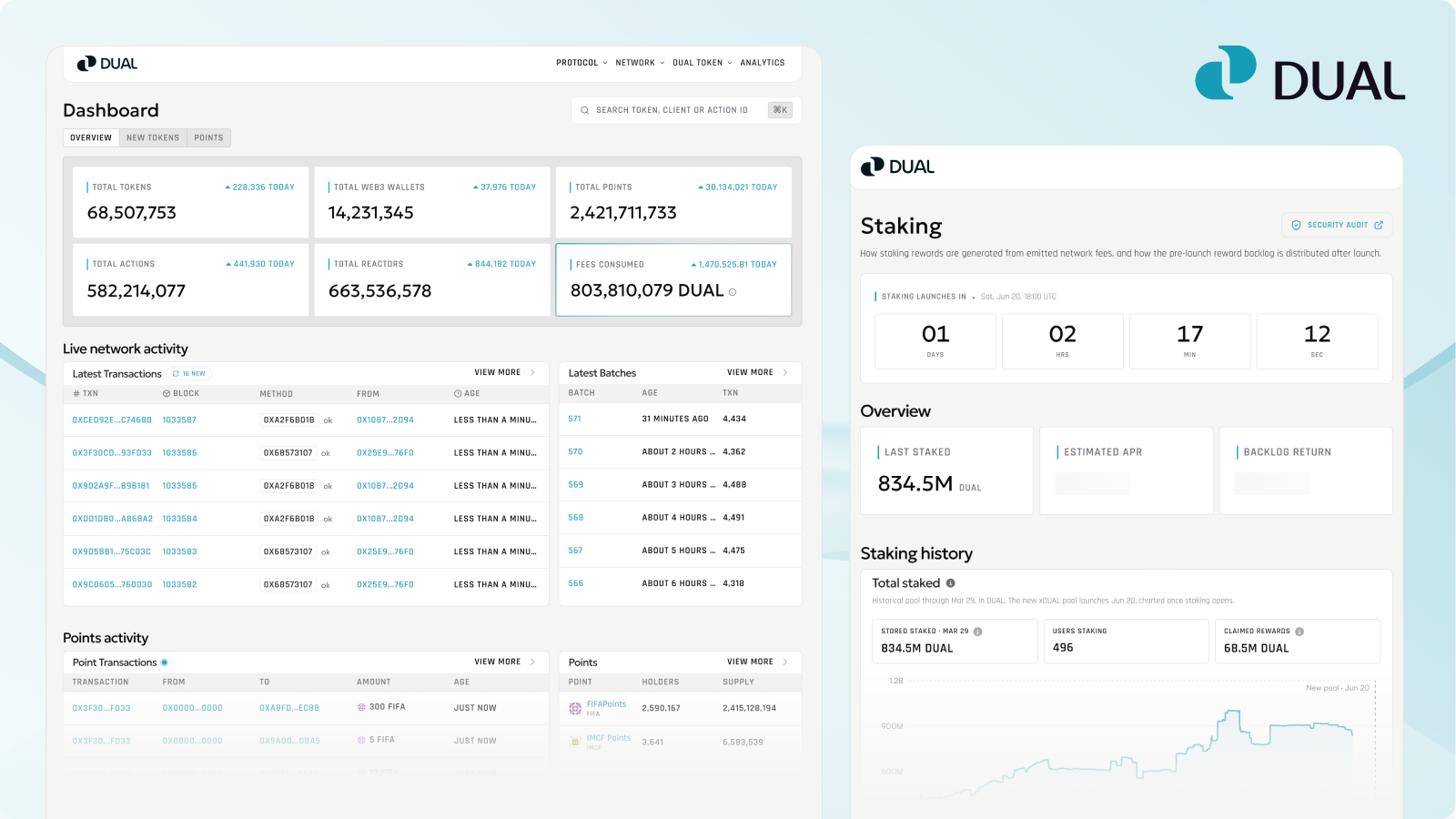
Below the headline statistics, the dashboard shows live network activity in real time: every new transaction hitting the Dual Mainnet, and every new batch of zero knowledge proofs being settled to Ethereum.
The Recent Mints feed shows every new token being minted across the network in real time, with the publisher address, the on-chain token address, and the DUAL fee paid per mint, each one verifiable directly on-chain. This is the programmable economy operating at scale, with every asset creation event settled transparently through the protocol.
A dedicated staking page is also live on the dashboard, currently showing a countdown to the June 20th launch alongside staking history, the launch reward model, and a live view of the growing backlog of accumulated rewards. Once staking goes live, this page will transition into a real-time view of staking activity, rewards distribution, and ecosystem participation as it unfolds.
The full dashboard is live at dashboard.dual.org, with dedicated views for largest clients, new tokens, and points activity across the ecosystem.
The Beginning of the Economic Layer
The programmable economy requires more than tokenization alone.
It requires infrastructure capable of coordinating applications, enterprises, operators, users, public systems, private deployments, and increasingly autonomous machine-driven interactions operating across different environments.
Staking and tokenomics are the systems that connect those layers together.
As more activity moves through the protocol, the relationship between participation and usage becomes increasingly important because the growth of the ecosystem itself becomes directly tied to the growth of the infrastructure underneath it. The more the protocol is used, the stronger the broader ecosystem becomes alongside it.
Governance, validator participation, operator coordination systems, and broader staking functionality will continue evolving as the protocol expands across both public and private deployments. At the same time, additional enterprise deployments are onboarding, more ecosystem integrations are launching, and the broader infrastructure behind Dual continues to expand around the same core foundation.
The infrastructure is already operating at scale, what comes next is opening that system further and allowing a much broader ecosystem to participate directly in its growth.