Introducing Dual: The Infrastructure for the Programmable Economy
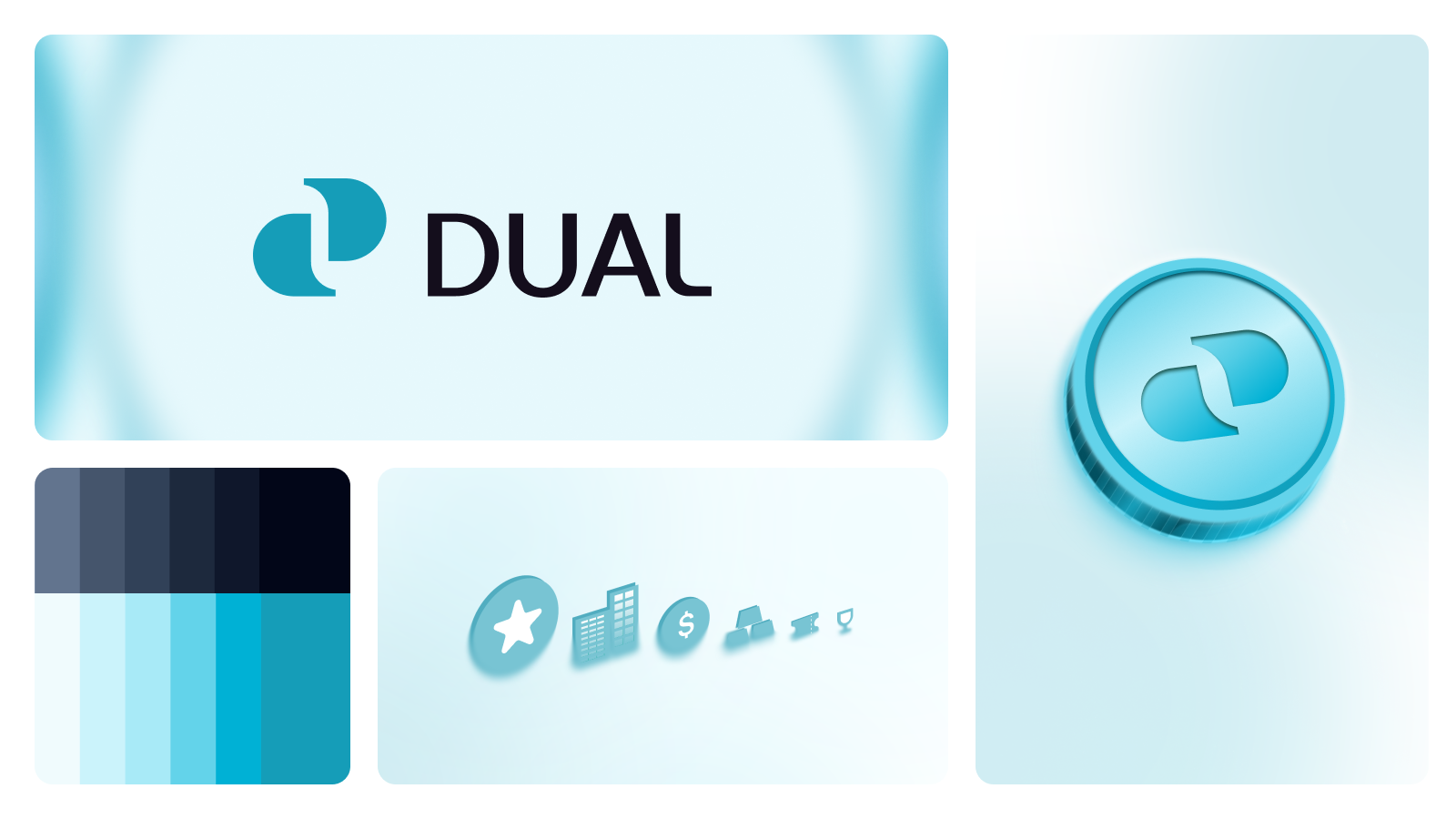
Today, we are introducing a new identity for everything we have been building: Dual. This marks the next chapter of the protocol formerly known as BLOCKv. It reflects the evolution of the platform over time, and more importantly, the direction it is now designed to take.
Over the past months, we have outlined a clear path forward: new infrastructure, deeper decentralization, broader access, and a protocol built for the next generation of programmable economies.
This transition is the result of years of work, shaped by enterprise deployments, large-scale integrations, and production environments where performance, reliability, and usability are critical.
Today, that evolution becomes visible.
Why Dual
BLOCKv pioneered programmable tokens before the industry had language to describe them, and built infrastructure that powered enterprise-grade experiences long before “Web3” became a standard term.
Since 2017, the platform has supported over 50 million deployed tokens, and facilitated one of the largest onboardings of regular users into Web3 with 11.5M+ unique wallets created. Through our strategic partnership with SmartMedia Technologies, Dual technology powers tokenized programs for global brands including Visa, PepsiCo, Unilever, and Olympic Games.
From the beginning, the vision was never limited to one category of digital assets. The idea was much bigger: that assets on the internet would become programmable, able to carry identity, logic, permissions, value, and utility in ways traditional systems never could.
The world is moving toward a future where physical and digital systems operate together. Real-world assets are being tokenized. Loyalty, commerce, identity, and ownership are becoming programmable. The boundary between off-chain and on-chain is getting thinner every day.
The name Dual reflects that directly, a Decentralized Universal Asset Layer. Physical and digital. Enterprise and open ecosystem. Infrastructure and application. Human users and autonomous agents. It represents the relationship between two worlds that are increasingly becoming one connected system.
BLOCKv defined the early phase of this journey. Dual is the identity for what comes next.
Built on Stronger Foundations
A big part of this next chapter is the new blockchain infrastructure underneath Dual.
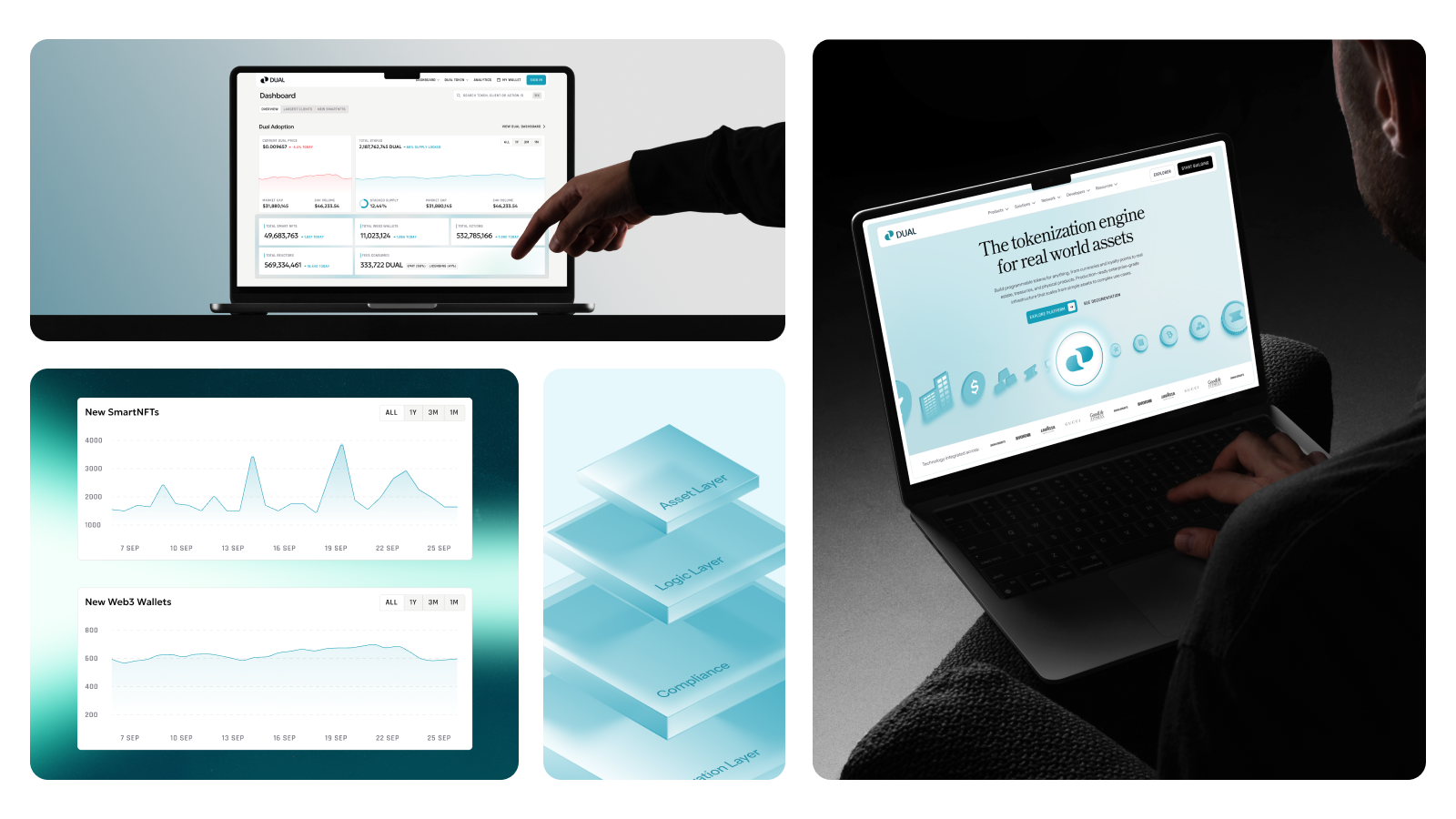
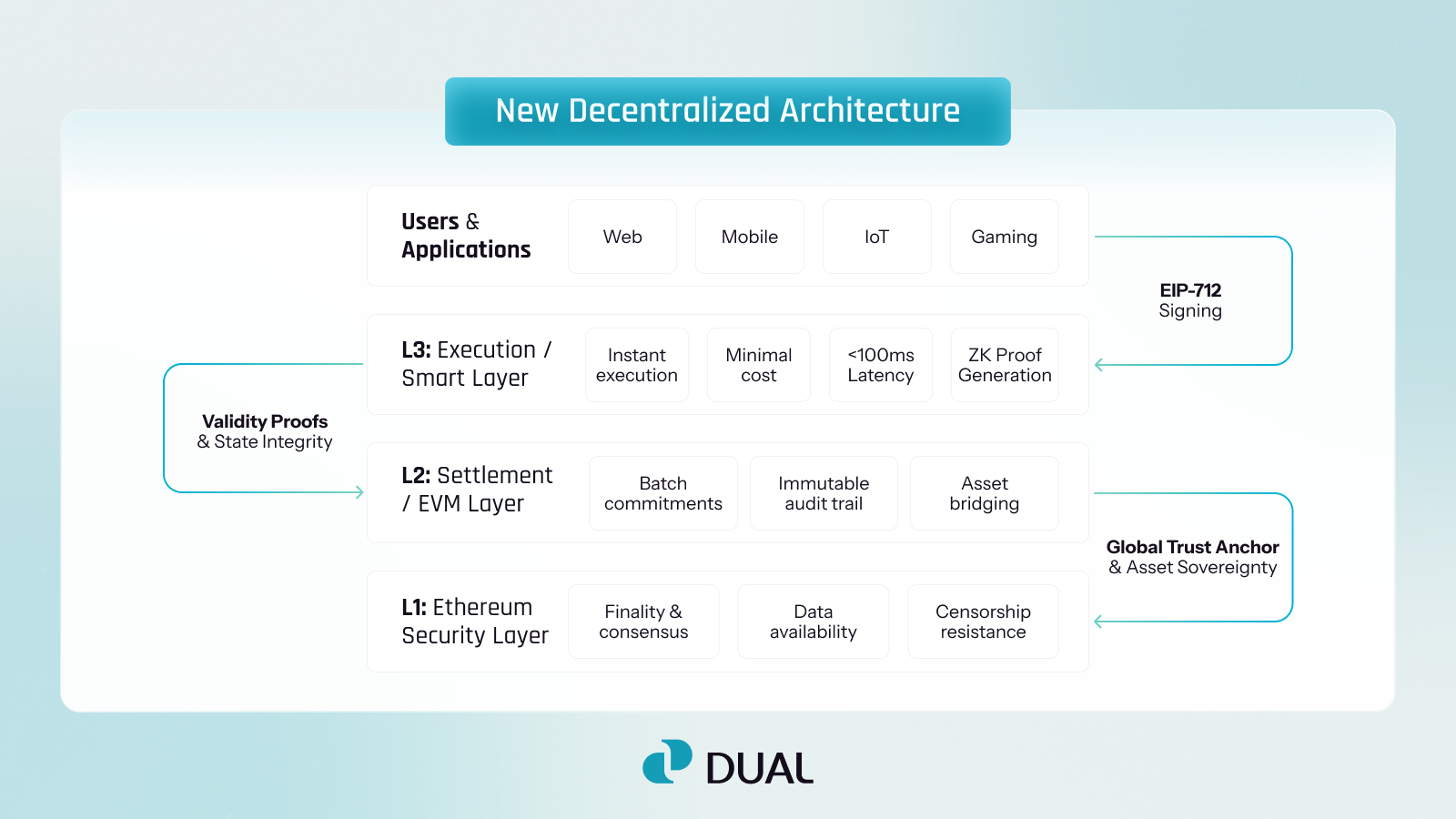
Dual operates as a Layer 2 blockchain on top of Ethereum, built using the proven Arbitrum stack, the same technology behind other enterprise-grade tokenization networks like Robinhood Chain. This architecture enables seamless interoperability with chains across the Ethereum ecosystem while inheriting Ethereum's security and decentralization.
The network is already live on testnet, with mainnet coming soon.
On top of Dual Chain sits a Layer 3, where the programmable logic of the protocol lives. This is where the asset logic runs. Where rules are enforced, permissions are defined, workflows are executed. It’s also where execution happens in real time, with low latency and minimal cost, making it practical for real applications to operate continuously.
The comprehensive three-layer architecture delivers enterprise-grade performance:
- Layer 3 (Programmable Layer): Powers programmable token logic and enterprise-scale applications with autonomous behaviors and agentic capabilities
- Layer 2 (Dual Network): Enables fast, low-cost transactions with cross-chain compatibility, serving both public users and enterprise clients
- Layer 1 (Ethereum): Provides foundational security, decentralization, and settlement finality for all network operations
Every interaction is verified through trustless zero-knowledge proofs, ensuring decentralized security at scale while maintaining the speed and cost efficiency enterprises require.
Assets can enforce conditions, manage permissions, and evolve over time. Applications can operate with the responsiveness required for real usage, while remaining anchored to a system designed for long-term integrity.
But Dual Chain is not limited to supporting the programmable asset layer alone.
We are working with partners to develop decentralized applications directly on top of the network. This extends the role of Dual beyond asset orchestration into a broader application layer, where independent products and ecosystems can be built on the same infrastructure.
As adoption increases, so does network activity. This drives further participation from developers, users, and partners, strengthening the ecosystem as a whole.
The architecture is designed to evolve in parallel with this growth.
Over time, the programmable layer will transition toward a more decentralized model, with multiple validators and native staking contributing to network operation. This expands participation beyond usage and introduces a more direct role for the community in the system’s security and coordination.
The Operating System for Programmable Assets
At its core, Dual is a protocol for programmable assets.
A programmable asset is not a static record. It is defined by logic. It determines how it can be used, transferred, or interacted with, and can represent a wide range of real-world and digital constructs, including ownership, provenance, compliance, access, and value.
This flexibility allows the same infrastructure to support a broad range of use cases, from real-world and financial asset tokenization to digital product passports, loyalty systems, certifications, commerce, and emerging models such as agentic commerce. What changes is the application. What remains consistent is the system underneath it.
Dual functions as an operating system for programmable assets.
Rather than requiring developers to build directly on low-level blockchain primitives, the platform provides prebuilt modules and standardized components that abstract much of the underlying complexity. This allows teams to work at a higher level, using familiar development patterns while still benefiting from the guarantees of on-chain infrastructure.
This approach has been central to the platform’s adoption.
By reducing complexity and aligning with existing development workflows, it has enabled both enterprise teams and independent developers to deploy tokenized systems in production environments. It has also made it possible to move from concept to implementation more efficiently, without compromising on reliability or scalability. Dual retains this model while extending it even further.
The protocol also remains multi-chain, supporting deployments across public networks as well as application-specific or enterprise environments. Different use cases require different deployment models, and the protocol is designed to support that flexibility.
What is new is how these environments are coordinated. Every asset and every interaction at the programmable layer is ultimately verified through Dual Chain, providing a consistent foundation for validation and coordination while allowing deployments to remain flexible across different networks.
Built for Builders, Teams, and AI
The next phase of the platform is defined by broader access.
Much of the development to date has taken place through enterprise integrations and production deployments. This work established the reliability and scalability of the system. The focus now shifts toward opening that infrastructure to a wider group of developers and participants.
The Developer Portal is a central component of this transition.
It provides access to documentation, APIs, tools, and development environments required to build on the protocol. The objective is to reduce friction and make it easier for teams to work with programmable asset infrastructure without needing to manage the underlying complexity.
We have also prepared a set of concrete examples that show how Dual can be applied across different use cases. These examples are designed to make adoption more tangible, demonstrating how the platform’s modules and infrastructure can be used in practice. This is necessary for ecosystem growth.
The protocol is not designed to be built by a single organization. It depends on a network of developers, applications, and integrations. Providing a coherent development experience and accessible tooling is essential to supporting that expansion.
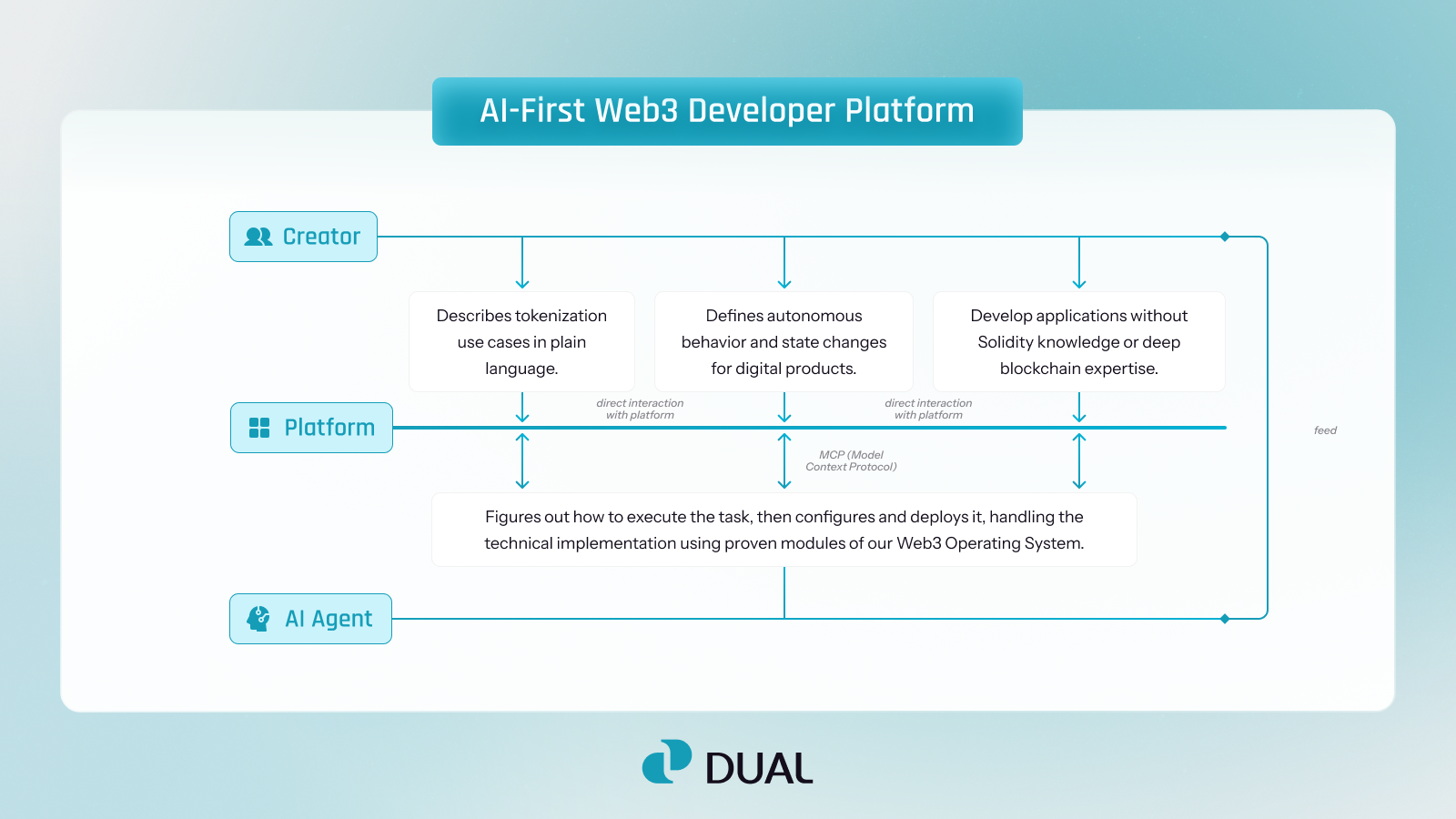
At the same time, the way software is built is changing. Artificial intelligence is becoming part of the development process, and increasingly part of how systems operate. Dual is designed to support this shift. The platform includes infrastructure that allows AI agents to interact directly with the protocol, enabling asset creation, configuration, and transaction execution as part of application workflows.
Because Dual provides prebuilt modules and standardized components, AI agents are not generating raw smart contract code from scratch. Instead, they compose tokenized applications using proven building blocks that are already secure and production-tested. This is particularly important in tokenized systems, where writing contracts directly is complex and prone to vulnerabilities.
In most AI-driven development environments, generating application logic can be relatively straightforward. In contrast, building secure tokenized applications has traditionally required deep expertise and careful auditing. By abstracting this complexity into standardized modules, Dual allows AI agents to operate within a controlled and secure framework.
This creates a uniquely strong approach for tokenized application development. It removes one of the biggest barriers in the space, building secure smart contracts, and fundamentally changes who can participate. By making it possible for AI agents, and by extension anyone, to securely create tokenized applications without deep smart contract expertise, it opens this category to a much broader audience.
What was previously limited to highly specialized teams becomes accessible to a much broader ecosystem of developers, operators, and creators.
As a result, the network is positioned to support a significantly larger and more diverse set of builders. That increase in participation translates directly into more applications, more activity, and a stronger, more resilient ecosystem around the protocol.
DUAL: The Economic Layer of the Network
On Tuesday, March 31st, the next stage of this transition begins with the launch of the DUAL token.
The token serves as the economic layer of the network, connecting usage, participation, governance, and long-term alignment into a single system.
DUAL is used across the protocol for multiple core functions: powering protocol services such as issuance, transfers, and certification; paying network fees on Dual Chain; and acting as the base asset for staking and governance.
As activity increases across the protocol, the role of the token becomes directly tied to how the network operates. Every interaction, whether minting assets, executing transactions, or running application logic, contributes to the economic flow of the system.
DUAL can be staked into xDUAL, which represents participation in the network’s economic and governance layer. Through xDUAL, participants are aligned with protocol usage and are able to take part in governance decisions over upgrades, safeguards, fee allocation, and network parameters.
As the protocol is used, fees are generated across asset creation, transfers, and application-level interactions. These flows are routed on-chain, with the majority distributed to xDUAL participants and the remainder allocated to treasury and ecosystem growth. This creates a direct relationship between network activity and participation.
Staking and governance will be introduced next month, as part of the next phase of network activation.
For existing VEE holders, the transition is designed to be straightforward.
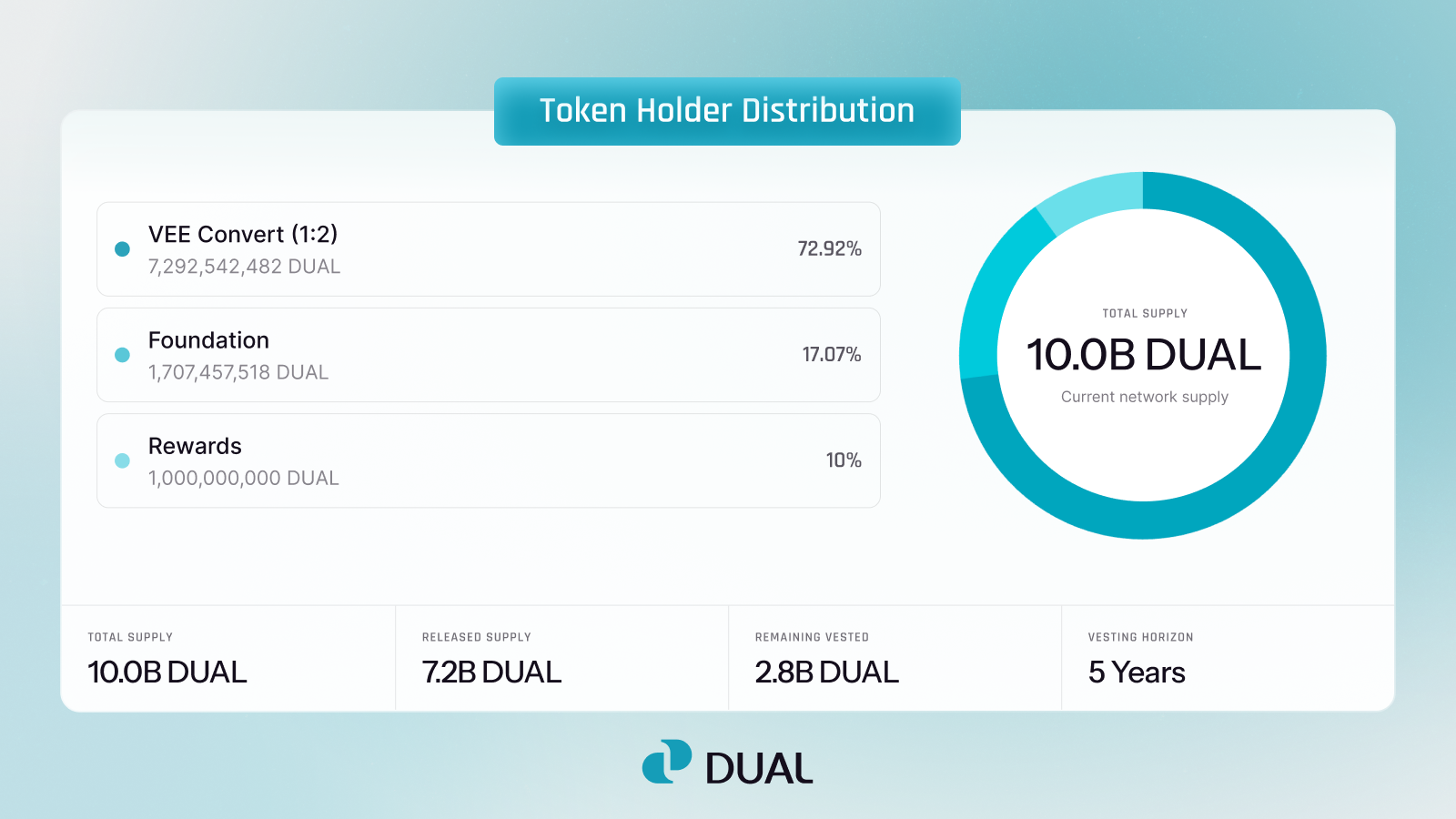
When the token bridge opens, tokens can be migrated at a 1:2 ratio, with each VEE converted into 2 DUAL. Additional details on the migration process, staking mechanics, and exchange listings will be provided in a dedicated article.
Approximately 73% of the total supply is reserved for the migration from VEE to DUAL, ensuring continuity for existing participants in the network. The remaining allocation is designed to support the next phase of growth and decentralization.
Around 17% is allocated to Foundation Treasury, used to fund ecosystem development, partnerships, and long-term network growth. The remaining 10% is allocated to the staking rewards, designed to incentivize participation and support the decentralization of the network over time.
Both the Foundation and rewards allocations are subject to a linear vesting schedule over five years, aligning incentives with the long-term development and adoption of the protocol.
The Beginning of the Dual Era
This transition builds on years of work.
The infrastructure has been developed, tested, and deployed in real-world environments. The platform has supported large-scale programs, integrated with enterprise systems, and proven that programmable assets can operate beyond experimentation. Today, it moves forward under a new identity.
Dual reflects what the platform has become, and what it is now designed to support. A system where assets are programmable by default. Where applications can operate across both digital and real-world environments. Where developers, enterprises, and autonomous systems can build on the same underlying infrastructure.
The network is live on testnet. The infrastructure is in place. The next phase – mainnet, token launch, staking, governance, and broader participation, follows from here.
At the same time, this is only the beginning. The protocol, tooling, and ecosystem will continue to evolve as adoption grows and new use cases emerge.
What to do right now:
- Explore the new home: Dual.org — New brand, new website, fully updated
- Access the dashboard: Monitor activity, and interactions with the protocol in one place
- Read the docs: Rebuilt documentation with unified architecture, AI, and live API references
- Explore the chain: The Dual explorer is live, with testnet activity running now
- Start building: The developer console is open for early access
Whether you’ve been with us for years or are just discovering Dual now, this is the point where everything comes together, and opens up.
Welcome to the programmable economy.